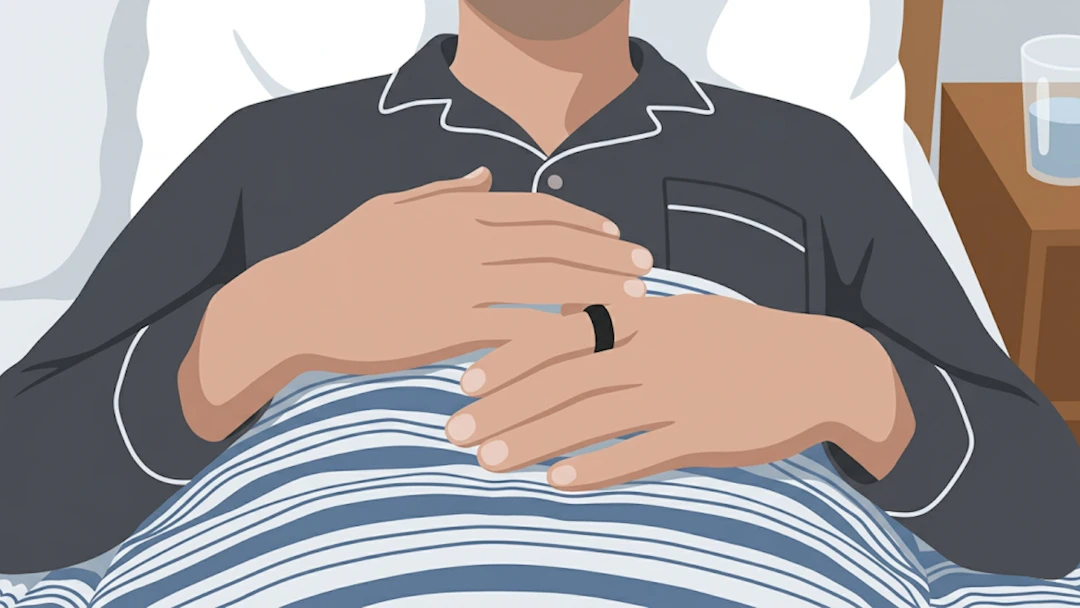
The Oura Ring 4 is the real deal for anyone serious about fixing their sleep
A month after switching from a smartwatch, checking my sleep score every morning has become a full-blown habit. And the quietly impressive part: looking at that score has made me reflect on my own behavior, thinking things like "yeah, I was on my phone way too long before bed last night." It's not just that the device collects data, it's that it nudges me to change what I do.
In this review I'll keep the usual talk about fit and battery brief, and dig into the parts that actually move the needle on sleep, based on real use: "What kind of numbers does the sleep score actually show?" and "Does looking at the data really change your life?"

Why a ring is such a strong format for sleep tracking in the first place
What makes a ring great for measuring sleep is simple: it doesn't get in the way of sleeping.
Wear a smartwatch to bed and there's always a presence on your wrist. With the Oura Ring there's no resistance to sleeping with it on, and zero pressure on the wrist. For the first few days I did think "am I really sleeping with a ring on?", but within a month it became almost unconscious. At this point I don't even notice I'm wearing it.
As someone who found wrapping something around my wrist to sleep quietly stressful, this alone means I can't go back. The ring as a format pairs remarkably well with sleep tracking.
The morning sleep score matches how I actually feel, more than I expected
.png?fm=webp&auto=compress&w=1080&q=75)
At the center of the Oura Ring is the 0 to 100 sleep score that shows up every morning.
To be honest about the actual numbers: low 50s on a bad night, high 70s on a good one. And what's interesting is how well that number lines up with how I feel.
The clearest example was a night I stayed at a hotel on a work trip and barely slept. The next morning's score was clearly down, and I found myself oddly convinced: "okay, this thing really is measuring something." The fact that I couldn't sleep at the hotel showed up right there in the number.
It's not perfect, of course. On nights I feel sleep-deprived, the total sleep time can still read on the longer side. But taking it all together, "it lines up pretty well with how I feel" is my honest impression after a month. I trust it enough to let the morning number make or break my mood a little.
Sleep stages show you the "contents" of your sleep
.png?fm=webp&auto=compress&w=1080&q=75)
As a breakdown of the sleep score, you can check your sleep stages in the app.
REM sleep, deep sleep, light sleep, and awake time. It shows the total duration and percentage for each, so you start to see that "even two seven-hour nights can have very different contents." Looking at the numbers, I realized for the first time that it's not just about sleeping long.
This stage data is what feeds into the behavior reflection in the weekly report I'll get to below.
The best part was that the weekly report actually changed my behavior
.png?fm=webp&auto=compress&w=1080&q=75)
The best thing about using the Oura Ring was that my own daily life changed.
As you use it, the correlation between behavior and score becomes obvious. A lazy weekend, or a night spent mindlessly scrolling before bed, scores low. Conversely, a busy workday capped with some stretching before bed scores high. What you did comes right back at you in the next morning's number.
And once a week, you get a weekly report. Seeing it, I started to reflect: "I stayed up too late this week," or "I'm building up sleep debt."
The upshot? I started putting my phone down before bed, and started being mindful about stretching. When you're shown the data, it turns out people change their behavior surprisingly readily, which honestly surprised me about myself. Improving sleep ultimately comes down to "can you change your behavior," so something that actually works on that is a big deal.
Honestly, I don't look at the granular metrics that much
The Oura Ring measures a lot of granular metrics, like overnight HRV (heart rate variability) and skin temperature, more than 50 in total.
But I'll confess honestly: I barely look at those detailed numbers. All I look at are the summaries, the sleep score and the weekly report. That alone changed my behavior plenty, so it's enough for me.
Data nerds can dig into every detail, and people like me who just want the summary can be done with the summary. The fact that it accommodates both styles is a quietly appreciated point.
Realistic battery routine that lets you measure every single night

Something that matters more than you'd expect in a sleep-tracking device is battery. Since you wear it to bed every night, if this falls apart your tracking gets interrupted.
The Oura Ring 4 lasts about 5 to 8 days on a single charge. Even better, a charging cycle fits neatly into shower time. About 30 minutes in the shower recovers roughly 30%, so if you leave it on the charger while you wash up, you're basically never caught out by a dead battery.
Situations like "I notice it's dead right before bed, so no tracking tonight" almost never happen, so the sleep data keeps piling up cleanly night after night.
What to know before you buy
If you're considering the Oura Ring for sleep, here are a few things to share up front so you don't end up saying "nobody told me" after buying.
A $5.99/month membership is required
Both the sleep score and the weekly report are membership-gated features. That said, every "it changed my behavior" experience I've described here exists only because of those membership analytics, so if better sleep is your goal, it's a price I can write off as a necessary cost. Thinking of it as a couple of coffees a month to make every night's sleep visible, I decided it was worth paying.
Getting your ring size right takes an extra step
Oura uses its own sizing system, and you really can't eyeball it. Order the free sizing kit, wear the sample size for a day (including overnight, since fingers swell), and only then place your order. Spending that one extra step up front saves you the headache of an ill-fitting ring later.
There's no vibrating alarm
This is the most disappointing point for sleep use. With all this sleep tracking going on, a gentle vibration to wake you during a light-sleep window would be perfect, I think every morning. And since it isn't on the newer Oura Ring 5 either, all you can do is hope for a future model. That said, you can cover wake-ups with your phone's alarm, so it doesn't undermine the value of the tracking.
Where it really shines
After a month, I've got a feel for the situations where the Oura Ring is especially useful.
First, travel and trips. A change of environment changes your sleep quality, and that shows up clearly in the score, making it easier to decide "I'm worn out from traveling today, let me turn in early." The score drop on the night I couldn't sleep at a hotel was a textbook case.
Second, managing your weekday-versus-weekend rhythm. Stay up late on the weekend and throw off your rhythm, and the weekly report tells you mercilessly. When the numbers say "you were all over the place this week," you actually feel like getting it together come Monday.
The common thread is that in every situation "it's a ring, so it measures while you forget it's even there." Asleep or on the move, the data piles up without you being conscious of wearing it.
If you want to weigh it against the alternatives on more than just sleep, it's worth comparing the major smart rings side by side before you commit.
Bottom line: the Oura Ring 4 is the best answer for anyone serious about changing their sleep
The Oura Ring 4 is ideal for people like this:
- People who genuinely want to improve their sleep quality
- People who want to look at the data and change their own behavior
- People for whom a "today was good / bad" summary is enough, over granular numbers
- People who don't want to feel a device's presence while sleeping
- People who prioritize tracking accuracy above all (for accuracy, it's Oura or nothing)
Before buying, the things to watch are: the monthly membership, getting your size right with Oura's sizing kit, and the need to handle wake-ups with your phone's alarm separately. If those seem fine, I don't think you'll regret it.
Having switched over from a smartwatch, my satisfaction is pretty high. Look at the sleep score and change my pre-bed behavior, then look back on the week with the weekly report. Ever since that habit loop started turning, nights that used to be just sleeping have become a little like an experiment.
I think it works best precisely for people who've been putting sleep on the back burner.