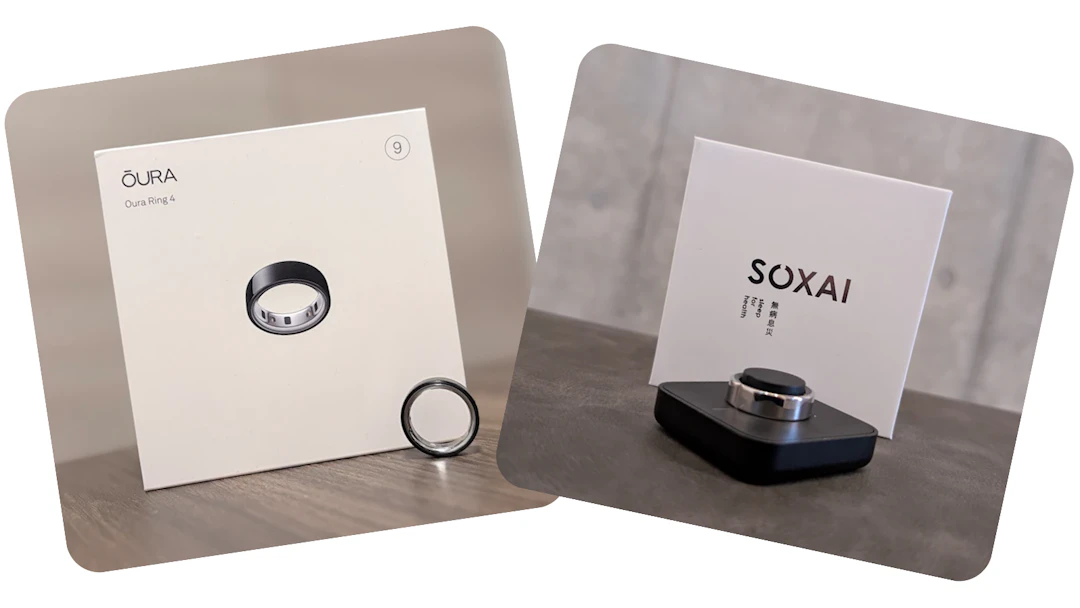
Two smart rings, worn side by side — Oura Ring 4 vs SOXAI RING 2
The Oura Ring 4 wins.
When you're choosing a smart ring, some things just can't be judged from a spec sheet. The Oura Ring 4 and SOXAI RING 2 are both titanium, both 100 m water resistant, both sleep trackers — yet they differ sharply in pricing model, sensor architecture, and the number of things they measure.
This article pits a subscription-based global brand against a one-time-purchase Japanese ring, based on actually living with both on my fingers. It's for anyone trying to build a health-tracking habit, or anyone wary of a wearable's ongoing costs.
Item | Oura Ring 4 | SOXAI RING 2 |
|---|---|---|
Price | $349–$499 | ¥39,980 (≈ $270; sold in Japan) |
Monthly cost | $5.99/month (≈ $70/year) | None (one-time purchase) |
Battery life | 5–8 days | Up to 14 days |
Charging time | 20–80 min | 60–120 min |
Charging method | Dedicated dock (wired) | NFC contactless |
Width / thickness | 7.9 mm / 2.88 mm | 6.7 mm / 2.7 mm |
Weight | 3.3–5.2 g | Approx. 2.1–2.7 g |
Sensors | 18-path multi-wavelength PPG / red, infrared & green LEDs / digital temperature / accelerometer | Optical PPG (Deep Sensing™) / skin temperature / AI-assisted 3D accelerometer |
Metrics tracked | 50+ items | 5 items (sleep score, heart rate, SpO2, steps, skin temperature) |
Water resistance | 100 m | 100 m |
Material | Titanium (hypoallergenic) | Titanium alloy (DURATECT surface treatment) |
Sizes | 4–15 (12 sizes) | Japanese 8–26 (10 sizes) |
Colors | 6 | 5 |
Supported OS | iOS / Android | iOS 12+ / Android 6.0+ |
Connectivity | Bluetooth Low Energy | Bluetooth 5.0 (BLE 5.0) |
Release (Japan) | July 17, 2025 | December 10, 2025 |
Oura Ring 4
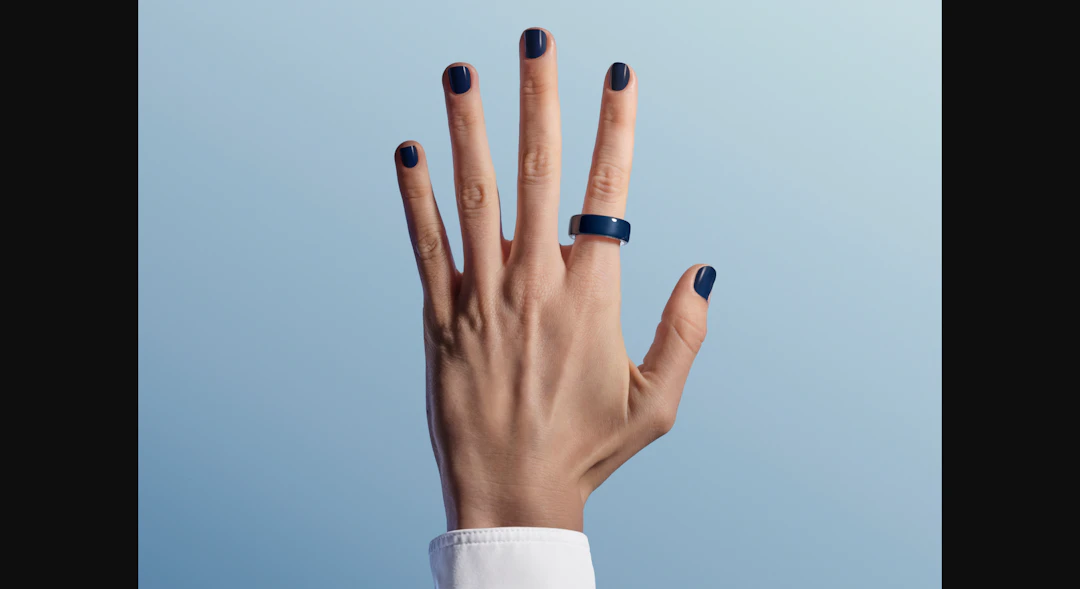
The fourth-generation smart ring from Finland's Oura Health, priced at $349–$499 depending on finish. Viewing your detailed health data requires a $5.99/month membership. It uses an 18-path multi-wavelength PPG and tracks more than 50 metrics.
SOXAI RING 2
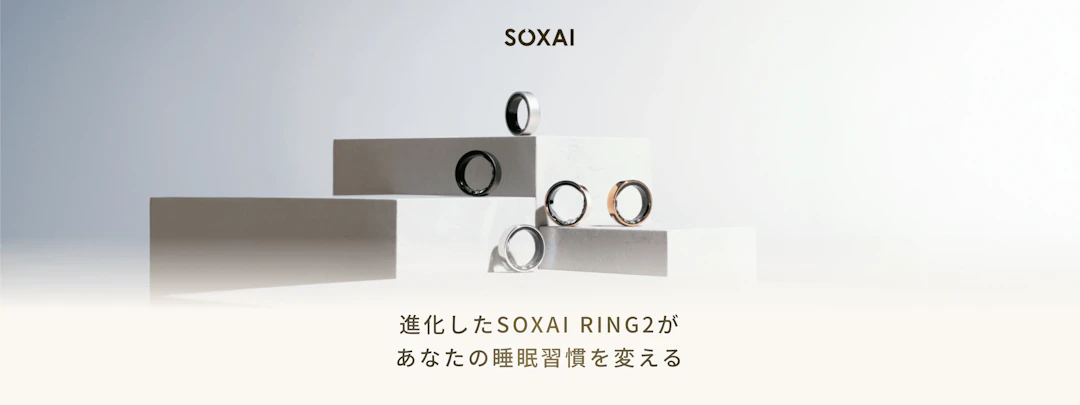
The second-generation smart ring from Yokohama-based SOXAI, on general sale since December 10, 2025. It's a one-time ¥39,980 purchase (about $270) with no monthly fee, currently sold primarily in Japan. Its sleep-analysis algorithm was developed under the supervision of the vice-chair of the Japanese Society of Sleep Research. The slim, light build measures 6.7 mm wide at 2.1–2.7 g, with NFC contactless charging and a DURATECT surface treatment.
Comfort — both reach "I forgot it's there," but not at the same speed
Both rings eventually get you to the point of forgetting you're wearing them. The time it takes to get there differs considerably.
The SOXAI RING 2 weighs roughly 2.1–2.7 g. From the moment you put it on, it has no presence. The charging cycle that stressed me throughout my smartwatch years — gone. Even though I'd never worn rings before, there was zero adjustment discomfort.
.png?fm=webp&auto=compress&w=1080&q=75)
The Oura Ring 4 also disappears during desk work. The product finish, including around the sensors, is genuinely premium, and it doesn't get in the way of sleep either.

But first there's the which-finger question. By process of elimination I settled on the index finger — except during meals, when it bothered me while holding chopsticks, so I'd move it to the middle finger. Finding "your own position" takes a quietly long stretch of trial and error.
The SOXAI RING 2 had almost no such break-in period. Lightness is justice.
On comfort, the SOXAI RING 2 leads by a step.
Sleep-tracking accuracy — same night, both rings, very different numbers
Sleep-tracking accuracy is the single biggest reason I picked the Oura Ring 4.
I wore the Oura Ring 4 and SOXAI RING 2 to bed on the same night. Here's the data from a roughly five-hour night.
Metric | Oura Ring 4 | SOXAI RING 2 |
|---|---|---|
Sleep score | 53 | 41 |
Time in bed | 1:23–6:19 (4 h 56 m) | 1:11–6:20 (5 h 09 m) |
Actual sleep time | 4 h 19 m | 4 h 36 m |
Sleep efficiency | 88% | 89% |
Time to fall asleep | 12 min | 23 min |
Light sleep | 75% (3 h 14 m) | 51% (2 h 27 m) |
REM sleep | 14% (36 m) | 22% (1 h 03 m) |
Deep sleep | 11% (29 m) | 23% (1 h 06 m) |
Average blood oxygen | 94% | 96% |
Breathing disturbances | Optimal (no disturbances) | Significant irregularity |
The fascinating part: it's the same night in the same body, yet the two rings produce completely different numbers.
The starkest gap is sleep-stage classification. Oura is strict — 75% light sleep, 11% deep. SOXAI reads 51% light, 23% deep. Oura seems inclined to count even a slight toss or a flutter in heart rate as light sleep.
The other fascinating one: breathing disturbances. Oura says "Optimal — no disturbances," while SOXAI raises a "Significant irregularity" warning. Blood oxygen was 94% on Oura, 96% on SOXAI — the ring with the lower number says everything's fine, while the higher one flags a problem. SOXAI's algorithm may simply be more sensitive to momentary dips in blood oxygen.
Which is right? These aren't medical devices, so there's no telling. But Oura grades harshly across the board — the "you still haven't slept enough" type. SOXAI is quick to catch breathing irregularities — the "hey, you might be snoring" type. Different specialties.
On sleep-tracking accuracy, the Oura Ring 4 wins. There's much more measurement detail in our standalone Oura Ring 4 review.
Battery logistics — the charging-frequency gap is bigger than it looks
The single biggest stress of my smartwatch years was charging. Take it off, charge it, put it back on. Quietly tedious — and eventually you just stop wearing it.
The SOXAI RING 2 has no such ritual. Rated at up to 14 days (for larger sizes), it comfortably runs a week per charge in practice. Sunday night, set it on the cradle. That's it. You think about charging four times a month. The relief of that is hard to overstate.
.png?fm=webp&auto=compress&w=1080&q=75)
The Oura Ring 4 is rated 5–8 days. The routine that worked best for me: set it on the dock whenever I take a bath. Thirty minutes of charging restores about 30%, so daily bath time easily covers it. Framed as "make charging part of the routine," it's solvable and far from fatal. But next to the SOXAI's "once a week, just set it down," it's one extra chore.

On battery logistics, the SOXAI RING 2 wins. Weekly charging really is that easy.
The apps — Oura's auto-sync vs SOXAI's manual sync is a night-and-day experience
Great hardware doesn't matter if the app makes you stop opening it. And these two apps are worlds apart.
The Oura Ring 4's app is modern and polished. Sleep score, activity, and stress level sit on a single screen, with less clutter and noise than, say, Huawei's band app. It auto-detects your commute walks and nudges you to take a break after long stretches of work. Data syncs by itself. Wake up, open the app, everything's already there. That alone makes you want to open it every day.
.png?fm=webp&auto=compress&w=1080&q=75)
The SOXAI RING 2's app is, frankly, so-so. The biggest problem is manual sync: data doesn't come in unless you open the app and sync it yourself. Worse, go more than 4 days without syncing and older data starts disappearing. Forget over a weekend and your weekday data is gone.
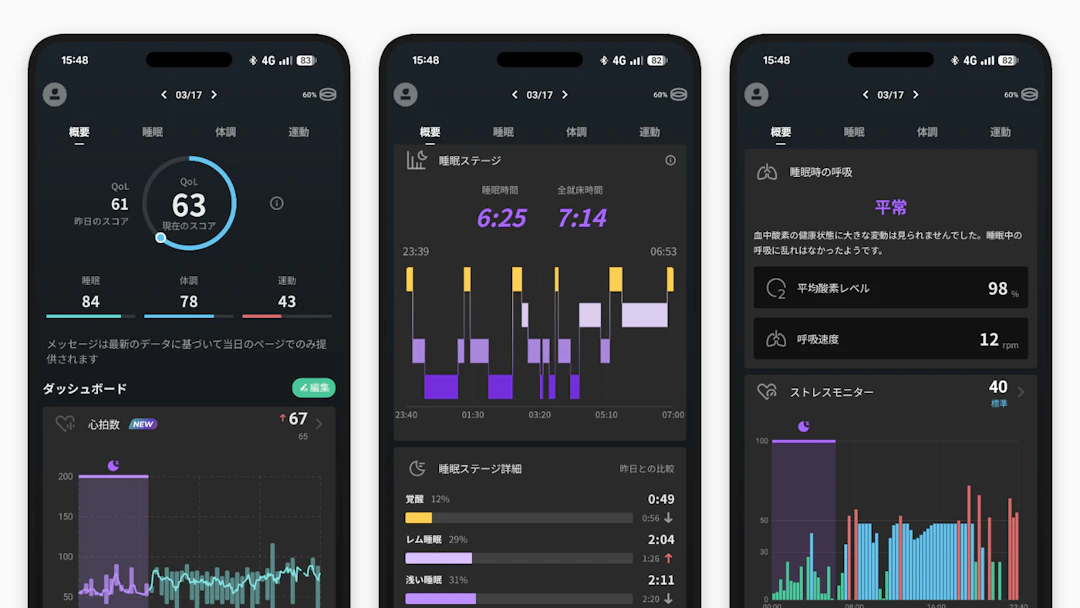
That said, a routine covers it. Wedge the app launch into your mornings — sync while brushing your teeth. Once that became habit, I've run months with zero data loss. Nothing to it once you're used to it; getting used to it is the hurdle.
On app experience, the Oura Ring 4 wins. Manual sync every time really is a drag.
Long-term cost — about $220 apart after two years
This one is a rout in the SOXAI RING 2's favor.
The SOXAI RING 2 is a one-time purchase of ¥39,980 (about $270). Zero monthly cost. One year, two years — it never costs another cent.
The Oura Ring 4 costs $349–$499 up front plus the $5.99/month membership. Taking the cheapest Silver finish ($349) on monthly billing:
- Year 1: $349 + ~$72 = ~$421
- Year 2: $349 + ~$144 = ~$493
- Year 3: $349 + ~$216 = ~$565
After two years the gap is roughly $220 — most of the way to a second SOXAI RING 2. After three, roughly $295. $5.99 a month looks small, but $70-plus a year keeps stacking. The longer you use it, the wider the gap.
In fairness, the Oura Ring 4 delivers accuracy and data volume for that money — whether the membership feels justified is personal.
On cost, the SOXAI RING 2 wins. Never thinking about a monthly fee is its own kind of comfort.
If you'd rather compare two subscription-free rings, see our SOXAI vs RingConn comparison.
The annoyances — drawbacks compared
Oura Ring 4
- Sizing is tricky: even after testing with the sizing kit, real-life fit can miss. I had to exchange mine once. Test thoroughly with the kit before buying, and when in doubt, size up.
- Membership required: $5.99/month adds up over the long haul. That said, the basic sleep score is viewable without a membership.
SOXAI RING 2
- Manual data sync: leave it more than 4 days and data disappears. Make "sync while brushing your teeth" a habit and it's a non-issue.
- No alarm: there are moments you'll miss a smartwatch's vibration alarm. Pairing with your phone's alarm is the only workaround.
Which ring for which person
You seriously want to improve your sleep → Oura Ring 4.
The same-night comparison made the accuracy gap plain, and 50+ metrics give your behavior change a solid evidence base. My own sleep data got me into bed in the 11 p.m. hour.
Your first smart ring, on a budget → SOXAI RING 2.
A ¥39,980 (≈ $270) one-time purchase with zero monthly cost. The ideal ring for finding out whether smart rings suit you at all.
You want to wear it long-term, uninterrupted → SOXAI RING 2.
Weekly charging and the featherweight build kept it on my finger for months straight. Continuous wear is the precondition for all the data, so this matters a lot.
You want rich health data in the app every day → Oura Ring 4.
Auto-sync, a polished UI, 50+ metrics. Open the app and it's all simply there.
And if you're still surveying the field, our roundup of five major smart rings maps out where everything stands.
Verdict: when in doubt, get the Oura Ring 4
Across five points of comparison, the Oura Ring 4 took two and the SOXAI RING 2 took three.
The SOXAI RING 2 wins on comfort, battery logistics, and long-term cost. It's a ~$270 one-time purchase with no monthly fee, charges once a week, and is light enough to forget. For first-time smart ring buyers and anyone allergic to running costs, it's the front-runner — and the experience of data genuinely changing your habits is absolutely available on the SOXAI RING 2 too.
I still recommend the Oura Ring 4.
The reason is simple: its sleep tracking is in a different league. Worn side by side on the same night, the sleep-stage classification diverged this much. Its heart-rate agreement with medical devices sits in the 99% range. What matters isn't how much data you get — it's whether you can trust the numbers. I could trust Oura's numbers, and that's what changed my behavior.
Yes, the $5.99/month is real. But if better sleep buys back next-day performance, to me that's worth the price.
I'm never going back to a smartwatch.
If you're curious about related products, our RingConn Gen 2 review — a month with the no-subscription smart ring is also worth a look.
Before you buy any smart ring, sizing is worth taking seriously — don't skip the maker's sizing kit; we've covered the details in our sizing guide.