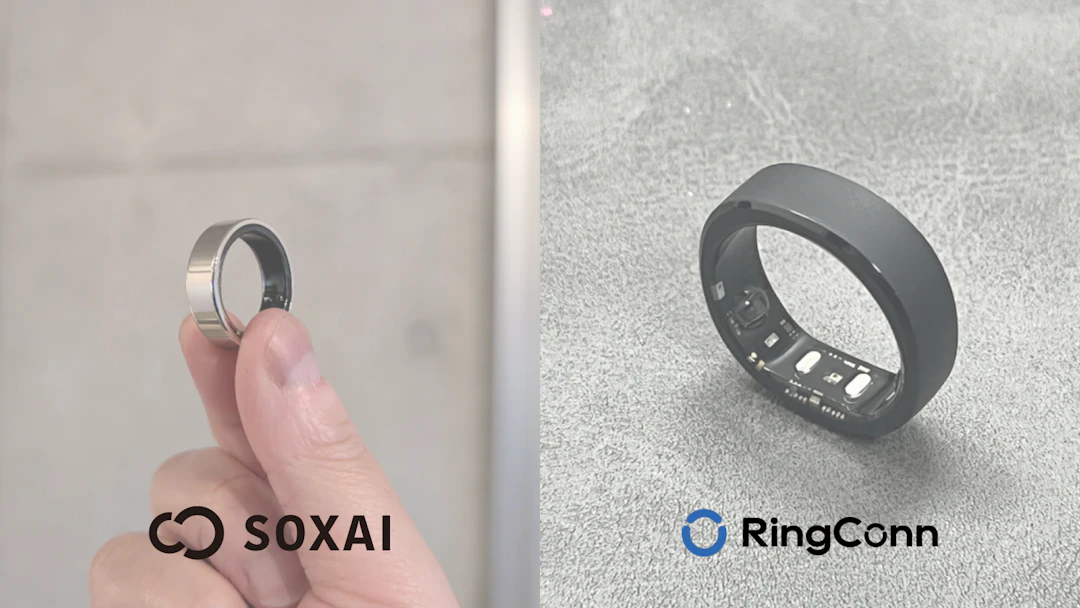
Two smart rings, months of real use — SOXAI RING 2 vs RingConn Gen 2
After months of wearing both, the ring that stayed on my finger was the SOXAI RING 2.
As smart ring options keep multiplying, Japan's SOXAI RING 2 and Shenzhen-based RingConn's Gen 2 stand out as two products with strikingly similar specs — in price, features, and materials alike.
Try to choose from the catalog numbers alone and it's genuinely hard to pick one. This article lays out what a period of using both side by side taught me — the differences that never show up on a spec sheet.
It's written for anyone considering their first smart ring, or anyone who owns one of these two and is thinking about switching.
One honest caveat up front: I used the SOXAI RING 2 for several months and the RingConn Gen 2 for about one month. Everything below is written with that gap in mind.
Item | SOXAI RING 2 | RingConn Gen 2 |
|---|---|---|
Price | ¥39,980 (≈ $270; sold in Japan) | $299 official (often discounted on Amazon) |
Release date | December 10, 2025 | February 2025 (Japan launch) |
Width / thickness | 6.7 mm / 2.7 mm | 6.84 mm / 1.94–3.52 mm |
Weight | Approx. 2.1–2.7 g | Approx. 2–3 g |
Battery life | Up to 14 days | Up to 12 days (up to 150 days with the charging case) |
Charging / time | NFC contactless / 60–120 min | Magnetic / approx. 90 min |
Metrics | Sleep score / heart rate / SpO2 / steps / skin temperature / HRV / stress | Heart rate / SpO2 / HRV / sleep / sleep apnea / stress / steps / skin temperature |
Sleep apnea monitoring | Detects warning signs (not a medical diagnosis) | Yes |
Subscription | None (one-time purchase) | None (one-time purchase) |
Water resistance | 100 m (swimming and sauna OK) | IP68 (100 m depth) |
Material | Titanium alloy | Aerospace-grade titanium alloy + PVD coating |
Colors | 5 | 4 |
Sizes | 10 sizes (Japanese sizes 8–26) | 9 sizes (US 6–14) |
Bluetooth | BLE 5.0 | BLE 5.0 |
Supported OS | iOS 12+ / Android 6.0+ | iOS 14.0+ / Android 8.0+ |
SOXAI RING 2
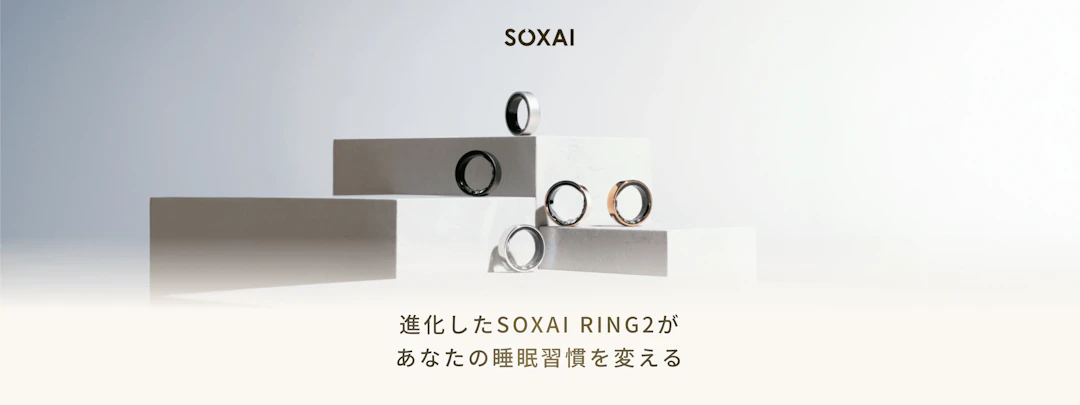
The second-generation smart ring from SOXAI, a startup based in Yokohama, Japan. It slims down the width and thickness from the previous model while keeping a wide size range and achieving up to 14 days of battery life. It's a one-time ¥39,980 purchase (about $270) with no subscription, and since December 2025 it's also carried by Japan's largest mobile carrier, NTT docomo. Its sleep-score analysis is supervised by physicians certified by the Japanese Society of Sleep Research. Note that it's currently sold primarily in Japan, so buyers elsewhere will need to import it.
RingConn Gen 2
The second-generation smart ring from Shenzhen-based RingConn — in Japan, its pre-order campaign set the all-time record on the crowdfunding platform Makuake. Its signature trick is the charging case: combined, the system runs up to 150 days, a feature no rival offers, which makes it especially appealing to frequent travelers. It adds sleep apnea monitoring, and while the official price is $299, it's frequently discounted on Amazon. The shell is aerospace-grade titanium alloy with a PVD coating.
If you're also weighing an Oura Ring, see our Oura Ring 4 vs SOXAI RING 2 comparison. For more depth on the RingConn, there's also our standalone RingConn Gen 2 review.
Comfort compared — the numbers are close, the feel is not
Honestly, before buying I thought: "They're both 2–3 g titanium rings, how different could they possibly feel?" I really did. They're different.
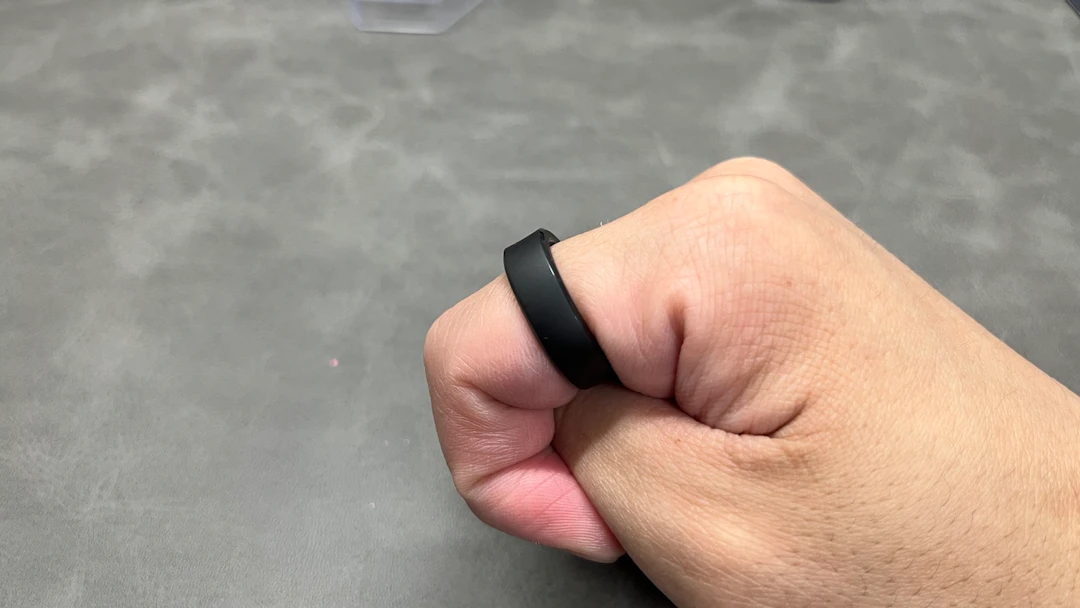
The SOXAI RING 2 weighs roughly 2.1–2.7 g. On paper that's virtually identical to the RingConn Gen 2's 2–3 g. But after months of continuous wear, I stopped taking it off entirely — not to sleep, not to wash my hands. The illusion that there's nothing on your finger is real; that's not an exaggeration. Back when I slept with a smartwatch, that chunky lump on my wrist bugged me with every toss and turn — and that discomfort simply went to zero. It comes into the sauna with me, into the bath. There's no reason to take it off.
.png?fm=webp&auto=compress&w=1080&q=75)
The RingConn Gen 2 is light too. Typing or carrying things, there's essentially no awkwardness. The matte black finish hides scratches and skin oil well — after a month of constant wear it still looked clean, which impressed me. But when I bend my fingers or grip something hard, there are moments where I notice: "ah, right, I'm wearing it." Even after a month, a firm squeeze still reminded me the ring was there. I also ended up taking it off to wash my hands. The mere fact that a "take it off" step exists is where you feel the gap with the SOXAI.
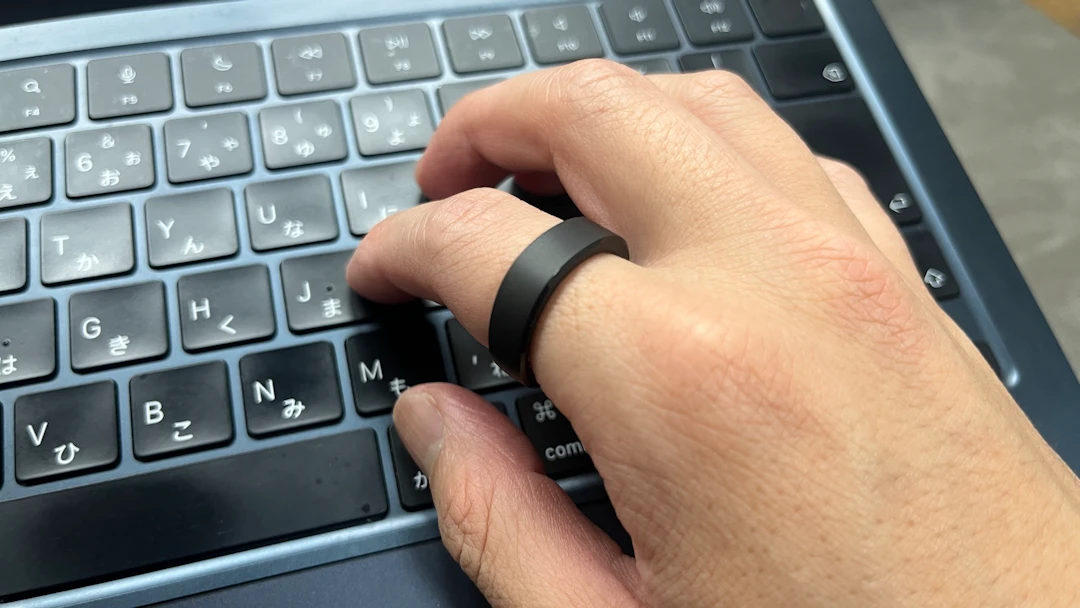
"Will I forget I'm wearing it?" wasn't something I thought about before buying — but after using both, it turned out to be the biggest difference of all. On comfort, the SOXAI RING 2 wins.
Battery logistics — the charging case is a big deal
The SOXAI RING 2 is rated for up to 14 days. In real use, one charge a week is plenty. Since it's off my finger only briefly for charging, I'm freed from the dilemma of losing data while it charges. Remembering the smartwatch-era stress of "take it off to charge, lose the data while it's off," a short once-a-week charge is perfectly comfortable.
.png?fm=webp&auto=compress&w=1080&q=75)
The RingConn Gen 2, meanwhile, runs up to 12 days on its own. That alone is roughly on par with the SOXAI — but RingConn has the charging case. With the case, up to 150 days. That's a different dimension entirely. No charger in your bag on a business trip. For some people, that alone is reason enough to pick the RingConn.

On battery logistics, RingConn Gen 2 takes it. The charging case is almost unfairly convenient.
Data-sync friction — SOXAI's manual sync is the one real shame
The SOXAI RING 2 doesn't support automatic background sync. You have to open the app manually to sync. And if you go more than 4 days without syncing, data starts disappearing, oldest first. Leave it 4 days and your data is gone. Genuinely gone. My workaround is building the app launch into my morning routine, and in months of use I've never lost data. But the fact that it takes a workaround at all is a mark against the design.
The RingConn Gen 2 had no such data-loss issues during my time with it. This difference is quietly significant.
On sync friction, RingConn Gen 2 wins. If SOXAI ever fixes its sync behavior the ring would be hard to fault — but as it stands, opening the app every morning is mandatory operating procedure.
Making use of your data — the apps differ in graphing depth
The RingConn Gen 2's app presents your data richly: bar charts, line graphs, pivot-style views. The stress check shows a four-level smiley character with a comment, which lands more intuitively than a wall of numbers. It also offers behavior-level health advice — "cut back on caffeine," "work in some exercise" — a nice touch that keeps the data from being something you merely look at.
.png?fm=webp&auto=compress&w=1080&q=75)
The SOXAI RING 2's app isn't as rich in graph variety or advice features as RingConn's. What it does have is the credibility of sleep-score analysis supervised by physicians certified by the Japanese Society of Sleep Research. Even after discounting the manual-sync weakness, I'm satisfied with the quality of the sleep data itself.
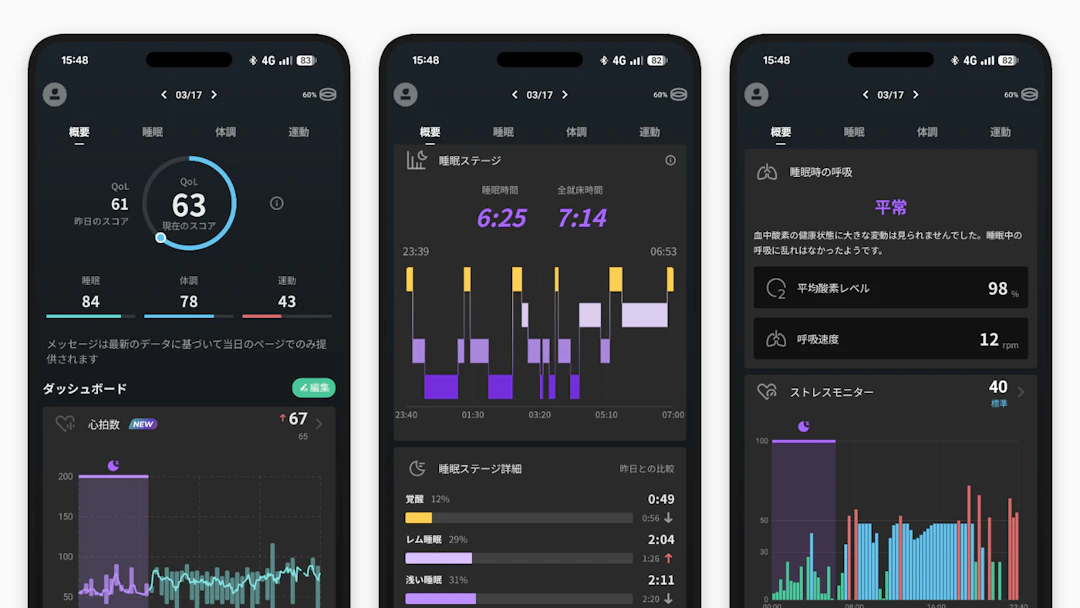
On app-experience richness, RingConn Gen 2 wins. If you love examining your data from every angle — if you want opening the app to be fun — RingConn will make you happier.
I wore both to bed on the same night — real sleep-data comparison
Comparing specs and impressions alone didn't feel entirely fair, so I wore the SOXAI RING 2 and the RingConn Gen 2 to bed on the same night. SOXAI on one hand, RingConn on the other. In the morning I opened both apps and lined up how two rings recorded the same night's sleep. Here's the result.
Metric | RingConn Gen 2 | SOXAI RING 2 |
|---|---|---|
Sleep score | 61 (Good) | 41 (Caution) |
Time in bed | 1:23–6:15 (4 h 52 m) | 1:11–6:20 (5 h 09 m) |
Actual sleep time | 4 h 27 m | 4 h 36 m |
Sleep efficiency | 91% | 89% |
Light sleep | 50.7% (2 h 22 m) | 51% (2 h 27 m) |
REM sleep | 21.4% (1 h) | 22% (1 h 03 m) |
Deep sleep | 23.2% (1 h 05 m) | 23% (1 h 06 m) |
Average blood oxygen | 97% | 96% |
Breathing disturbances | Normal | Significant irregularity |
The fascinating part: the sleep-stage percentages match almost exactly. About 50% light sleep, 21–22% REM, about 23% deep sleep. Agreement this close tells you the two rings' algorithms are designed remarkably alike — and it's fair to assume the sensor accuracy is comparable too.
The sleep scores, however, differ wildly. RingConn says 61 — "Good." SOXAI says 41 — "Caution." Same night, 20 points apart. This is a difference in grading philosophy. SOXAI appears to weight achievement against your target sleep duration heavily, and it shows no mercy to a 4.5-hour night. RingConn is more lenient — or rather, it seems to weight sleep quality (deep-sleep share and the like) more.
Most interesting of all was the "breathing disturbances" verdict. RingConn: "Normal." SOXAI: "Significant irregularity." Complete opposites. Blood oxygen averaged 97% on RingConn and 96% on SOXAI — nearly identical — yet the interpretations diverge completely. SOXAI's algorithm seems to react sensitively to momentary dips in blood oxygen (the instants where breathing pauses), catching irregularities that an average value can't show. Scary information, but the useful kind.
What this comparison taught me isn't "which one is accurate" but that they differ in what they choose to tell you. SOXAI grades harshly, which fuels motivation to fix your habits. RingConn reassures you and lets the visualizations help you judge for yourself. Which is better is a matter of taste — but for me, the strict-talking SOXAI is the one that actually changed my behavior.
Sleep tracking you can stick with — consistency decided it
Most people buy a smart ring to understand their sleep. I was the same.
The SOXAI RING 2 is built primarily for sleep tracking, with the credibility of analysis supervised by physicians certified by the Japanese Society of Sleep Research. After months of continuous use, the health data went from "something I glance at" to material that actually changes how I live. No comfort friction means I wear it to bed every night. Wearing it every night means the data never breaks. And once months of data pile up, you inevitably start thinking "maybe I should get to bed a bit earlier." That shift kicked in only after months of continuous use.
.png?fm=webp&auto=compress&w=1080&q=75)
The RingConn Gen 2's sleep tracking is also strong. It records four stages — REM, light, deep, awake — and extends to apnea detection and even eye-movement measurement. As a parent whose nights routinely top out at five hours, being confronted with a sleep score around 63 has its own kind of value (protecting your sleep time is a genuinely hard mission these days…). Both products can detect signs of apnea, but RingConn measures more items.
But judged as "sleep tracking you can actually stick with," the SOXAI RING 2 comes out ahead precisely because its comfort adds zero friction. It may lose on the number of metrics, but wearing it to bed stress-free every night is what sustains the habit, and the habit is what makes the data valuable. As a sleep-tracking experience, SOXAI RING 2 wins.
The annoyances — drawbacks compared
SOXAI RING 2 drawbacks
- No vibration alarm — the morning alarm is the one thing that makes me miss a smartwatch. If the ring could wake me, it would be perfect. Workarounds: settle for your phone's alarm, or keep a minimal band-style smartwatch purely as an alarm clock.
- Manual app sync is mandatory — leave it more than 4 days and data disappears. Fold it into your morning routine and it's fine, but it's a design flaw I'd love to see fixed.
- Japanese sizing and availability — sizes run on Japanese ring sizes (8–26), and the ring is primarily sold in Japan, so overseas buyers need to import it and convert their size.
RingConn Gen 2 drawbacks
- No vibration either — same as SOXAI: the no-vibration club. An industry-wide smart ring problem, really.
- Get the sizing right — it uses US ring sizes (6–14). Whatever region you're in, checking with the free sizing kit before ordering is essential; smart ring fit is unforgiving.
We've covered how to use sizing kits and how the systems compare in our smart ring sizing guide.
Which ring for which person — how to choose
- You want 24/7 sleep tracking and never want to take the ring off → SOXAI RING 2. Zero comfort friction is its greatest weapon. Sauna and bath included.
- You care most about data visualization and app experience → RingConn Gen 2. Graph variety, health advice, the stress-check UI — RingConn's app is simply more fun to open.
- You want to charge as rarely as humanly possible → RingConn Gen 2. 150 days with the charging case is a killer feature for frequent travelers.
- You're switching from a smartwatch → SOXAI RING 2. The "freed from the wrist" experience hits hardest with SOXAI. Once you've escaped the smartwatch tossing-and-turning problem, you can't go back.
If you'd like a deeper look at how smartwatches and smart rings differ, we've written a full comparison on that topic too.
Verdict: when in doubt, get the SOXAI RING 2
On the spec sheets, these two are nearly even. Pricing is close too — SOXAI at ¥39,980 (about $270) and the RingConn frequently discounted to a similar level. Both are one-time purchases with no subscription.
So what actually separates them? Things you only learn by wearing them.
The SOXAI RING 2 dissolved completely into my life within months. It's comfortable enough to forget, so there's never a moment to take it off, so the data never breaks. The reason my sleep data ended up changing my behavior is precisely that "forgettable" quality. The manual-sync weakness is real, but it's coverable with a morning routine.
The RingConn Gen 2 shines for its 150-day battery system and its data visualization. The app experience is unambiguously better on RingConn. But even after a month, a firm grip still reminded me the ring was there.
With smart rings, I've come to believe everything reduces to one question: do you forget you're wearing it? In the end, it all came down to whether I could keep it on every single day. The SOXAI RING 2 passed that test.
When in doubt, get the SOXAI RING 2. It's a buy. If you're also weighing an Oura Ring, see our Oura Ring 4 vs SOXAI RING 2 comparison. For more on the RingConn, our standalone RingConn Gen 2 review goes deeper. And if you're still browsing beyond these two, our roundup of the major smart rings compares the wider field.